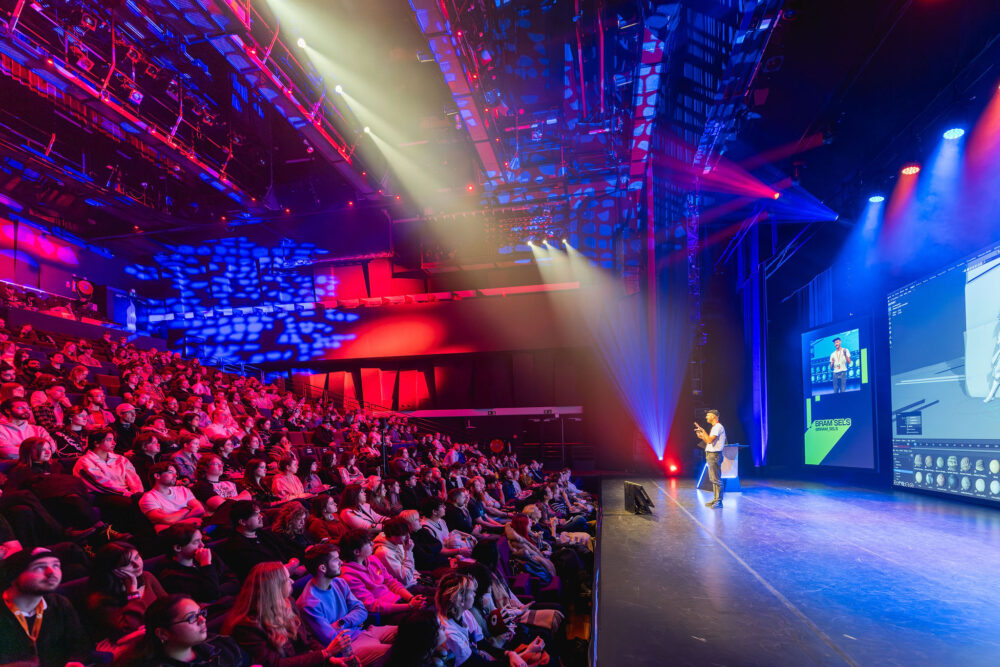
During two fully packed days our sold out Dutch Game Week Conference showed us many exciting dimensions of the Dutch and international game industries. From serious gaming to esports, from indie to AAA games, from student projects to multi-awarded productions, there was a bit of everything to enjoy for any game aficionado or professional.
The conference brought together visionary studios, creators, and innovators for a packed program of talks, panels, portfolio reviews, and hands-on game demos. Together we discovered how leading voices in the industry are pushing boundaries and shaping the next generation of games.
We took notes, we gathered insights, we bottled inspiration. Read below some of our highlights and take-aways (arranged in no particular order)!
Not a fan of written words? Enjoy then our Dutch Game Week after-movie created by the ever amazing Jochem de Vet.
Quite an interesting experience to be able to play The Midnight Walk in the games demos section, and then listen to not just one but two of the MoonHood creators, each sharing their own take on the game’s design process.From Olov Redmalm’s amazing talk what stuck with us was the idea of a 𝗰𝗿𝗲𝗮𝘁𝗶𝘃𝗲 𝗯𝗼𝗼𝗺 𝗲𝗺𝗲𝗿𝗴𝗶𝗻𝗴 𝗳𝗿𝗼𝗺 𝗻𝗼𝘁𝗵𝗶𝗻𝗴𝗻𝗲𝘀𝘀 and the prompt to find creativity by confronting ourselves. Very eye-opening his stories from his ascetic journey: “My brain was so bored, I started hallucinating. We were not allowed any writing instruments and paper, but I eventually ended up stealing a pen and started writing my ideas on toilet paper.”We also enjoyed his tips about creating the sound design for games:
– for dialogue it helps to go into an empty room and start talking with yourself on different voices, keeping in mind that characters have different opinions and they can also lie
– speech to text tools can be very handy in the moments when you try to think and act like your game characters
Bram Sels is no stranger to Playgrounds events yet he always manages to bring something new to the table. “If you’re an artist” he encouraged our audience “don’t skip leg day. Do your drawing exercises! Also, try to make yourself invaluable to the team. If you are a character designer but there is no character design work needed in a particular moment in the production, try to help out with something else, like contributing to the environments for instance”.
Guerrilla‘s Arno Schmitz also talked about the importance of doing personal explorations and being prepared to put in the hours. “If you want to make any meaningful piece of art, be prepared to sink some serious hours into it”, he mentioned. “Personal projects are great for exploring new directions and learning new tools. Fill your portfolio with works you want to make more of. Spending one extra week on a design and trying to put it in a story, can make the difference between getting 0 and 5 job offers. ”
“Don’t wait until you feel ready. It’s always good to have a close group of peers to bounce ideas with. Applying constructive criticism is the best way of growing.”
Robert Sammelin from Embark Studios took the idea of personal explorations even further. “When you are trying to design a dragon, don’t look at other dragons. Try, for example, to look at Rococo chairs, and integrate those in the dragon design” Robert mentioned as a method of pushing your creativity further. “A successful concept doesn’t need to be fully rendered but it does need a very good idea. The execution can always have various degrees.”
“When I entered the industry” he confesses, “I was rubbish. I was lucky to find work. But then I really worked for it because you can never rest on the laurels of past achievements“.
Some artists however shared insights also about the challenges of mixing passion and work, and the difficulties of setting proper boundaries between a job and personal life. Koen Deetman from Keoken Interactive extensively talked about his burn-out in probably one of the talks that touched our audience the most. “The worst part of a burn-out”, he shared, “is no longer being in control”. Koen also mentioned how he has learnt to recognise the signs from their early onset, and how he sometimes had to take radical and heart-breaking professional decisions in order to ensure he no longer gets into that difficult spot.
His presentation covered other challenging aspects as well, such as the arrangements that need to be made with publishers. “When it comes down to working with publishers, everything needs to be put down on paper.”
Koen made sure however the audience caught some good vibes as well “I think the small developers are in a good spot right now” he mentioned, and explained how the current context favours more indie projects seeing the light of day.
Another talk very enlightening regarding the legal aspects and challenges of game development, was given by René Otto from Deviant Legal. In many ways, the talk many creators needed and didn’t know it. He shared many practical insights about contracting, the protection of IPs, as well as the problematics of “ownership” in some situations. “If you work with freelancers the most important thing to consider is the copyright laws“, René pointed out. He also stressed that it is always very important to get on the same page on who owns what, because in many instances freelancers are actually seen as employees from the point of view of companies, while they might actually see themselves differently (as in holding more rights over their work).
Following his presentation, we were very excited to see that René also won the Dutch Game Award for Inclusion, on 3rd of December.
The ups and downs of working in the gaming industry were perfectly encapsulated in Laurens Rutten’s talk. Being part of CoolGames, Laurens was one of the forces responsible for many Facebook hit games, such as AngryBirds. Things however fell apart when the Cambridge Analytics scandal hit the platform. Laurens talked about facing the challenge of reinventing themselves and starting to develop for an entirely different platform. Once again raising to the top. CoolGames became the ‘gaming kings’ on Snapchat. Yet their incredible success was cut once again short when Snapchat chose to discontinue their games in 2023.
All these experiences have helped the company grow even stronger and Laurens shared some of the things that have helped them such as making good plans for exit strategies. He also shared insights about the advantage of working withinvestors such as: their often providing a diverse network, introducing you to other investors, providing credibility, can help with M&A – either acquiring others or sell your own company, can give you time to learn, take risks and make mistakes.
The importance of explorations and making mistakes was also highlighted in the Opportunities and Power of Applied Gaming panel. “Research is important but trials are also vital for the process. So are making mistakes and trying things out.” The panelists discussed also some misconceptions about educational games stating that they are sometimes approached in the design process in a similar way to entertaining games, while, on other occasions, it is thought of applied gaming that it can’t be a creative process because the game needs to fit a purpose. But creativity can also reside in constraints and it is very fulfilling to contribute to a game that actually helps people increasing the quality of their lives.Indeed, if there is one final thought after enjoying such a rich program, is that games and their creators have an incredible force of make our minds access new realms, unleash our creativity and simply bring joy. We hope that everybody was left inspired to continue playing but also keep on diving into the amazing world of play!